In preview — general availability coming soon

The Active Semantic Layer (TASL)

Connect your databases.
Query with any API or protocol in 5 minutes.

Query 46 heterogeneous data sources with GraphQL, Cypher, SQL, gRPC, or MCP — all over the same federated schema, on the engine you choose: Trino, DuckDB, ClickHouse, Postgres, Snowflake, Databricks, or BigQuery, or the embedded Trino-compatible engine that ships in the box. Cross-source joins fan out through federation; single-source reads and writes route direct to the driver, transactional and sub-100ms. Reach it over pgwire, Bolt, Arrow Flight, gRPC, JDBC, REST, WebSocket, Airport, or an MCP server — the same governed schema, every way in, one governed way out.

Semantic compilation, from logical design to physical execution: the instant API, the legal join paths, the governance rules, and the telemetry that audits every query all fall out of one model — the registration that describes your data is the same one that operates, governs, and audits it. The federation engine and the data sources beneath are yours to choose.

Three languages, one schema

GraphQL, Cypher, and SQL all query the same federated schema and retarget to any source dialect. Governance applies identically across all three — not three integrations, but one.

Read and write

Provisa carries analytical and transactional flows through the same governed API: cross-source reads fan out through federation; writes and single-source reads route direct to the driver — transactional and sub-100ms.

Smart routing & recorded transforms

Single-source queries bypass federation entirely. Materialized views record the transform that built them, so queries are transparently rewritten onto a fresh MV — partial join matches included. Hot lookups inline as VALUES CTEs.

Query interfaces & wire protocols

Write in three languages. Connect over nine protocols.

The query language and the wire protocol are independent choices, and the same governance reaches every entry point — your applications, BI tools, and AI agents alike.

GraphQL

Per-role schemas with field-level visibility, cursor pagination, and aggregates. Schema-constrained to registered relationships — valid by construction. Apollo APQ included.

SQL

Full SQL over federated data — correlated subqueries and all. Single-source queries bypass federation entirely for sub-100ms latency.

Cypher

Graph queries over the same federated schema. Traverse relationships as edges, union sources, walk variable-length paths — identical governance.

pgwire

Any Postgres client (psql, DBeaver, DataGrip, pandas read_sql) connects on port 5439. pg_catalog answered in-memory so schema browsers just work.

Bolt (Neo4j)

Neo4j Browser, Bloom, and official drivers run Cypher over Bolt. Each role surfaces as a provisa_<role> database.

Arrow Flight

High-throughput columnar streaming over gRPC; accepts GraphQL or SQL. Unbounded result sets, no server-side materialization.

gRPC model API

Auto-generated .proto from the registered schema — typed query and insert RPCs per table, streamed responses.

JDBC & REST

BI tools (Tableau, Power BI, DBeaver) over JDBC; JSON:API 1.1 at /data/jsonapi/{table} with sparse fieldsets and filter expressions.

Natural language

NL→SQL/Cypher/GraphQL powered by Claude, with an interactive validation loop before anything executes.

MCP server

A Model Context Protocol server — stdio and remote Streamable HTTP — lets AI agents like Claude query your governed, federated data as tools. The OAuth token maps to a role, so every call is governed; agents get no bypass.

Airport (DuckDB)

Any DuckDB client attaches Provisa as a database — ATTACH 'grpc://host' AS p (TYPE AIRPORT) — and queries the governed federated schema. Filters and projection push down; writes update by primary key.

WebSocket & SSE

Subscriptions stream near-real-time change events. Backends: Postgres native, MongoDB native, CDC, or polling — also fanned out over Kafka.

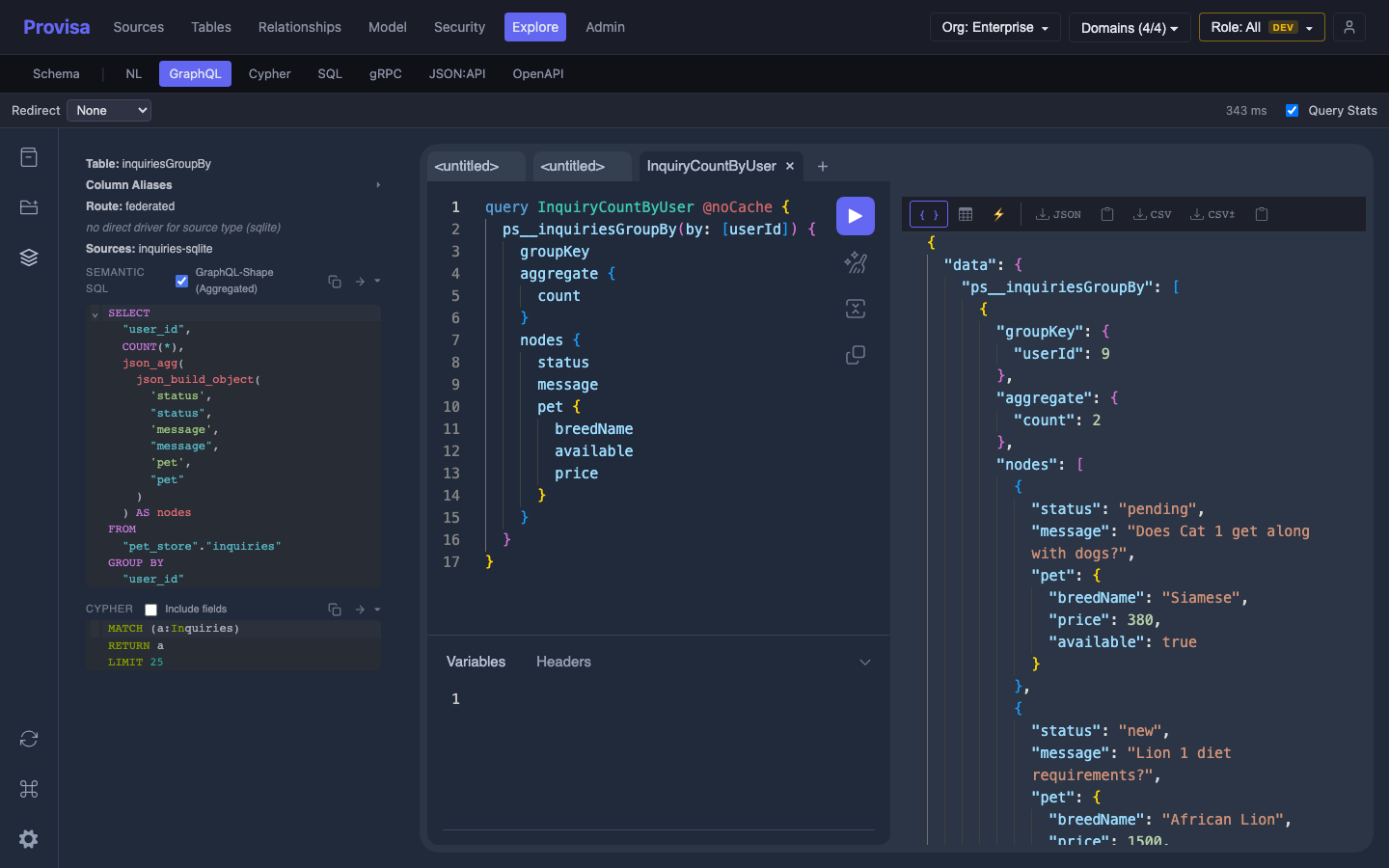
The Query Language Explorer: a GraphQL query with its live Semantic SQL and Cypher translations in side panels.
Write a GraphQL query; see its live Semantic SQL and Cypher translations, then jump into either editor.

Active, query-time governance

Six layers. Every language. Every transport.

Governance is applied uniformly — there is no query path that bypasses it. Add a source, column, or relationship and every layer applies automatically.

  1. 0

    Introspection filtering

    Schema browsers only ever see what the role is allowed to see.

  2. 1

    Public access

    Anonymous surface is explicit, never accidental.

  3. 2

    Domain access

    Roles reach only the domains registered to them.

  4. 3

    Row-level security

    Per-table, per-role WHERE injection — inherited recursively.

  5. 4

    Column visibility & masking

    Regex, constant, or truncate masking with role-based bypass.

  6. 5

    Predicate guard & approval

    Pre-execution ABAC hook over webhook, gRPC, or unix socket.

Relationships are governed too — explore with guardrails. A JOIN, or a graph traversal, is legal only if it matches a registered, approved relationship; unapproved paths are rejected and logged. So the query and graph explorers let people roam the model freely — and let AI agents discover what connects to what — while every path stays inside the edges policy sanctioned. Each relationship carries a human- and agent-readable reason for why the traversal exists.

And it's a per-role capability: the guardrail is a single flag on the role. Leave it on for analysts and agents who should stay on the rails; take the training wheels off for a trusted role and it writes unconstrained JOINs across the whole federated schema — same governed path, just without the relationship guard.

Data sources

46 source types through one API.

Graph and RDF sources are first-class, not adapters. Register REST, GraphQL, gRPC, WebSocket, or RSS endpoints as governed tables — federated joins across API and relational sources work transparently.

  • PostgreSQL
  • MySQL
  • MongoDB
  • Cassandra
  • Elasticsearch
  • Neo4j
  • SPARQL
  • Kafka
  • Snowflake
  • Databricks
  • BigQuery
  • Fabric
  • ClickHouse
  • DuckDB
  • Google Sheets
  • CSV / Parquet
  • Excel · DOCX · PPTX
  • SharePoint
  • Splunk
  • S3 · FTP · SFTP
  • REST APIs
  • GraphQL APIs
  • gRPC APIs
  • RSS · WebSocket

An instant data lake — governed on arrival

You don't register files — you register a location. Point Provisa at a folder, a bucket, or a SharePoint site and it crawls the whole tree recursively, discovers every file, and registers each as a governed table. Not just CSV and Parquet — Excel workbooks, and even Word, PowerPoint, HTML, and Markdown documents converted to tables. Over local disk, s3://, ftp://, sftp://, or SharePoint.

Connect SharePoint and its lists enumerate as schemas you can query. Run a Splunk search and the results come back as a table you can JOIN to your business data. A live Google Sheet is just another table. Each lands under the same RLS, masking, and relationship rules as everything else — a data lake that's governed the moment it exists, not months later.

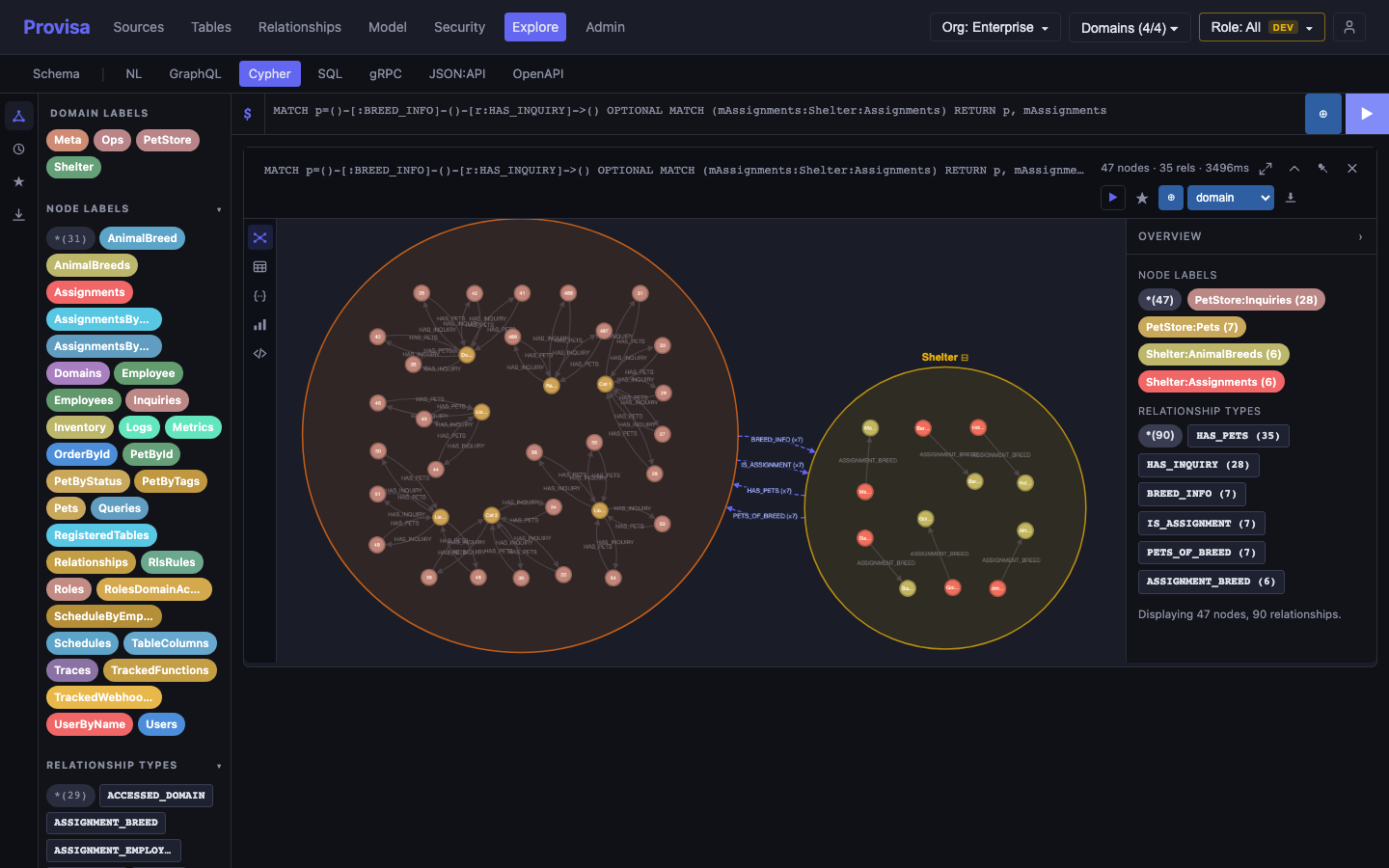
The federated schema explored as a live graph: domain and node labels, relationship types, and variable-length traversals across sources.
The same federated schema, explorable as a live graph — domains, node labels, and relationships across every source.

Observability as data. Traces, metrics, and logs are collected via OpenTelemetry, compacted into Iceberg, and registered as queryable tables — join customers to queries to see who ran what and how long it took.

Materialized views

Analytics datasets you declare, not pipelines you orchestrate.

Build a materialized view over a view, a source, or another MV — a dependency graph of derived datasets from raw source to final analytics table. No orchestration DAG to write or babysit.

Layered by design

MVs stack on views and other MVs. Your whole analytics layer becomes one declarative graph — the same model that describes and governs your data.

Recorded transforms

Each MV records the SQL or join that built it and the input signals it read (Iceberg snapshot, RDB watermark). Queries transparently rewrite onto a fresh MV — partial-join matches included.

Refresh by freshness

An MV rebuilds only when an upstream input actually changed. A change fans out through the graph to its dependents — demand-driven, not recompute-everything.

Refresh by calendar

Or on a TTL / interval when time, not data, is the trigger. Freshness and calendars are the only knobs — no hand-maintained schedule.

Governance still applies to every derived dataset: an MV is a governed table like any other, so RLS, masking, and relationship rules hold all the way up the graph.

Enterprise-ready

Airgap-ready. Installs from your own Artifactory.

The embedded profile ships the entire runnable system — precompiled UI and all — as a single Python wheel. Regulated and airgapped orgs already trust Artifactory-as-PyPI, so there's no new supply chain to approve: no Docker registry to mirror, no JVM, no root.

  • SQLite control plane + embedded DuckDB engine — no Docker, no daemon
  • Bring your own engine: Trino, Databricks, Snowflake, Postgres, ClickHouse, Oracle — whatever works, one env var
  • Reproducible and hash-pinned; passes the same CVE gate as every wheel

Vendor leverage

Locked-in ecosystems become replaceable execution engines.

Provisa gives you leverage over your vendors. It front-ends your disparate systems so your semantics live with you, not your vendors — turning locked-in ecosystems into replaceable execution engines you can swap without rewriting a query or a policy.

No lock-in — engine or source

Insulate your data consumers from infrastructure churn: your model, semantics, and governance live above the infrastructure, not inside it. Swap the engine — embedded to Trino to your warehouse; new CTO, new strategy, switch it to Databricks — the queries and policies don't change. Re-point a table from Oracle to Postgres, or MongoDB to Snowflake, and consumers never see it move.

That turns data modernization into an incremental effort instead of a big-bang cutover: migrate sources table by table behind a stable governed API, with one uniform governance model applying to legacy and modern sources alike throughout the transition.

Your warehouse should be a replaceable component, not a place you get stranded — when your semantics live above the engine, vendors compete for your workloads instead of holding them hostage.

We don't lock you in either

Provisa is a handful of primitives — domains, tables, relationships, masking, views — compiled deterministically. No proprietary modeling universe to learn, no black box: your model is portable declarative config, and the SQL it compiles is yours to read, export, and keep.

Use it as scaffolding in dev if you want. The semantics you write don't die with the tool — because they were never trapped inside it.

Physical fragmentation, logical coherence

Performance needs fragmentation — the right engine per workload, materialized copies at the right granularity. Consumers need one coherent model. The old cost of fragmenting the physical was fragmenting the logical too: a pile of models with clashing objectives and granularity, physical detail bleeding into logical design.

Provisa splits them. Specialized engines and materialized views underneath, one governed logical model on top — and the physical never bleeds into the contract your consumers see. The knobs that fragment for speed live in the same declarative model that keeps you coherent, so going faster never spawns a second modeling mess.

Domains as products — delegated, not centralized

Give a domain its own owner and scoped rights to build it: register sources, publish tables, wire relationships, ship views — all inside their domain, none of it reaching another. Central policy still governs every query; authorship is federated, enforcement stays absolute. Optional — off by default, on when you need it.

Promote config like code

Analysts and developers work freely in a dev lane — register sources, publish tables, wire relationships. Their changes export as a unified-diff config patch that flows to test, then prod, reviewed in git like any pull request. Because the estate is declarative, promotion is a diff, not a migration.

Where a release also moves data, a materialized view can carry the transform — and land its output into a real source table, not just the internal store. True data migrations may still call for imperative scripts outside Provisa — the model promotes cleanly; the heavy data movement is yours to run.

The economic takeaway — you set the compute bill

Pair semantic governance with intelligent query routing and the value shifts from just managing access to actively optimizing compute economics. Provisa becomes a single point of leverage to optimize execution speed, minimize network egress, and dictate exactly how much you pay vendor compute engines on any given query.

Get Provisa

Download and run in a minute.

Signed desktop installers for every OS, or pip install the embedded runtime. The native tier boots immediately — no Docker, no JVM. Preview builds; join the list for the general-availability release.

Or install from PyPI

The whole runnable system — precompiled UI included — as a single wheel. Airgap-ready over an Artifactory PyPI mirror: no Docker, no JVM, no root.

Federate against your own engine any time with TRINO_HOST/TRINO_PORT.

Deploy anywhere

From a laptop to a cluster — same platform.

Double-click on your desktop, pip install in an airgap, or provision a cluster with the tooling your ops team already runs.

Desktop installers

Signed macOS, Windows, and Linux installers — each with a one-click demo build that boots a sample stack you can query immediately.

Python wheel

pip install "provisa[embedded]" — the whole runnable system, precompiled UI included. Airgap-ready over Artifactory. No Docker, no JVM, no root.

Kubernetes · Helm

A production Helm chart deploys the control plane, workers, and engine to any cluster — scale the federation tier horizontally behind one governed API.

Cloud & VM · Terraform

Terraform modules for AWS, Azure, and GCP stand up a VM or cluster deployment end to end.

Describe your data and govern it in the same act.

One governed path for analytical, application, and human data movement.